

May 21, 2022
What the Acceleration of Artificial Intelligence Means for Pharma
What the Acceleration of Artificial Intelligence Means for Pharma
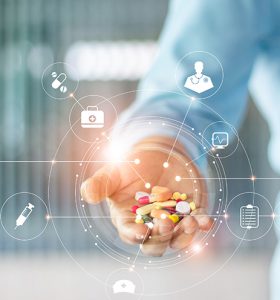
Artificial intelligence (AI) has helped the pharmaceutical industry progress at a rapid pace. Pharma has been using AI to improve efficiency by automating certain tasks and freeing up humans to perform more complex labor for several years.
More recently, pharmaceutical companies have embraced the power of AI to improve patient outcomes in several ways. AI-powered machines can analyze massive amounts of data in a short amount of time, allowing researchers to make sense out of their data sets and develop new medicines faster than ever before. The unprecedented rate at which companies were able to create, test, and distribute COVID-19 vaccines is due in part to the use of AI and machine learning (ML).
How Pharma Can Leverage AI
Here are some of the ways pharmaceutical companies can use AI to improve processes and improve outcomes.
Improve overall efficiency
Because they can analyze large amounts of data in a short period of time, AI-powered computers improve processes and optimize manufacturing. These machines can work 24/7 without breaks, allowing them to perform significantly more work than a human on any given day.
By automating tasks previously performed by humans, pharma companies can train their workforce to handle more complex challenges and allow computers to manage more manual functions while also reducing the risk of human error.
Develop more effective drugs
It can take as long as 10 years for a new drug to be developed and distributed, including six to seven years of clinical trials. Research shows that less than 15 percent of drugs actually pass the clinical trial phase of development. A lot of the time and money currently being used for drug development ends up going nowhere and leading to zero results.
Implementing AI into drug discovery can make the process more efficient and lead to better results. The amount of data AI can analyze and the depths the analysis can go can help researchers make better decisions when developing drugs. Challenges still exist, such as gathering enough quality data for AI to analyze appropriately. We should expect to see pharmaceutical companies start implementing AI and ML into drug development, which will ideally lead to a higher number of drugs that pass clinical trials and a shortened lab-to-market timeline.
Hope for rare disease treatment
Ninety-five percent of rare diseases lack an FDA-approved drug. A primary reason why treatment for many rare diseases has not been studied is the sheer amount of time and money it takes to get a drug from lab to market.
With AI, researchers can gather more data from clinical trial participants using remote monitoring tools and apps. This will allow researchers to collect more data points and keep costs down for participants who no longer need to worry about travel and other expenses associated with clinical trials.
Takeaway
The recent pandemic forced pharma companies to shift forward technologically in several ways, including implementing AI into their processes. The results will help researchers and manufacturers develop more effective drugs in less time to help patients with a wide range of diseases.
References
Paul, D., Sanap, G., Shenoy, S., Kalyane, D., Kalia, K., & Tekade, R. (2021, January).
Artificial intelligence in drug discovery and development. Retrieved February 17, 2021, from
https://www.ncbi.nlm.nih.gov/pmc/articles/PMC7577280/
Rare facts. (2020, December 16). Retrieved February 17, 2021, from
https://globalgenes.org/rare-facts/
S Biopharmaceutical Research & Development: The Process Behind New Medicines. (2015). Retrieved February 17, 2021, from http://phrma-docs.phrma.org/sites/default/files/pdf/rd_brochure_022307.pdf
Waltz, E. (2020, September 29). What AI Can–and Can’t–Do in the Race for a Coronavirus Vaccine. Retrieved February 17, 2021, from https://spectrum.ieee.org/artificial-intelligence/medical-ai/what-ai-can-and-cant-do-in-the-race-for-a-coronavirus-vaccine
Wong, C., Siah, K., & Lo, A. (2018, January 31). Estimation of clinical trial success rates and related parameters. Retrieved February 17, 2021, from https://academic.oup.com/biostatistics/article/20/2/273/4817524
